
How Does Integrating Metal Stamping, Welding, and Assembly Simplify Your Supply Chain?
Combining metal stamping, welding, and assembly under one roof simplifies the supply chain by reducing the number of suppliers, cutting transportation costs, improving quality control, and shortening lead times. For OEMs managing stamped parts or welded assemblies, integrated manufacturing provides a more direct path from raw materials to finished products.
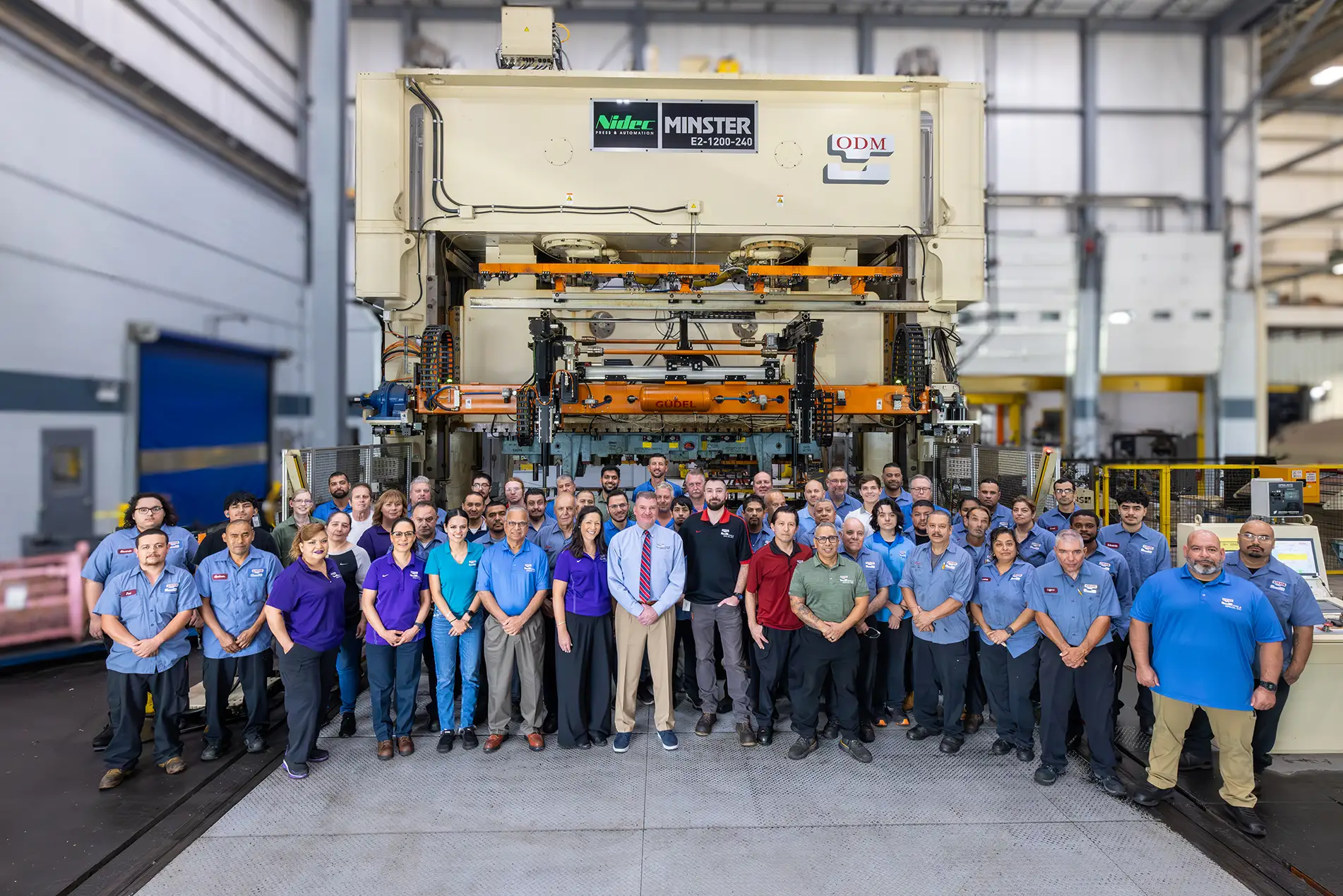
At ODM Tool & Manufacturing, we bring 80 years of manufacturing experience together with high-tonnage stamping, robotic and spot welding, assembly services, and a team built around quality and practical problem-solving. When more work stays with one partner, production becomes easier to manage, track, and keep moving.
What Is Integrated Manufacturing?
Integrated manufacturing brings multiple production steps together within one manufacturing partner. For metal programs, this may include stamping, welding, assembly, hardware insertion, tapping, cleaning, inspection, packaging, and other value-added services.
Instead of sending parts from one supplier to the next, more of the work happens under one roof. A stamped part can move directly into welding and assembly without leaving our facility, which reduces extra handling, transportation, communication gaps, and delays between operations.
How Does Integrated Metal Stamping and Welding Reduce Suppliers?
Every supplier added to a program creates another point of coordination. Purchasing teams manage another quote, another purchase order, another schedule, another shipment, and another set of quality expectations.
Integrated metal stamping, welding, and assembly reduces that complexity. Our team can manage more of the production flow, helping customers spend less time coordinating between separate stampers, welders, assemblers, and secondary service providers.
ODM Tool & Manufacturing supports progressive and transfer stamping, robotic welding, spot welding, riveting, tapping, hardware insertion, cleaning, and assembly within the same operation. We provide our customers with fewer handoffs and a clearer path from production planning through final delivery.
Why Does One-Source Manufacturing Improve Lead Times?
Lead times often stretch when parts move between multiple suppliers. Even when every supplier performs well, freight time, queue time, schedule changes, and receiving delays can slow down the overall program.
Integrated manufacturing shortens the path between steps. A stamped component does not need to wait for outside shipping before welding begins; a welded assembly does not need to move to another vendor before hardware insertion, cleaning, or final assembly. More work can happen in sequence, with one team managing the timing.
Our large-tonnage stamping capabilities, including 1200- and 1500-ton presses, support demanding programs requiring strength, repeatability, and capacity. Combined with welding and value-added manufacturing, those capabilities help keep complex production work moving through a more controlled process.
What Are the Cost Benefits of Combining Stamping, Welding, and Assembly?
Piece price matters, but total production cost often tells the fuller story. A lower quoted price from one supplier can lose value when the program requires extra freight, additional handling, more administrative time, and rework caused by communication gaps.
Turnkey manufacturing can help reduce hidden costs by keeping related operations together. When stamping, welding, and assembly are planned together, the process can be built with the next step in mind.
Integrated manufacturing can help reduce:
- Freight and transfer costs
- Supplier management time
- Administrative coordination
- Delays between production steps
- Rework tied to miscommunication
- Extra handling between vendors
For high-volume programs, even small improvements in movement, timing, and coordination can make a meaningful difference over the life of a part.
How Does Integrated Manufacturing Improve Quality Control?
Quality becomes harder to manage when multiple suppliers touch the same part. A dimensional issue, weld concern, or assembly problem may require backtracking through several vendors to understand where the issue started.
Integrated manufacturing gives our team clearer visibility across the process. Stamping, welding, assembly, and inspection can be aligned around the same documentation, requirements, and quality expectations.
ODM Tool & Manufacturing supports this approach through certified quality systems, poka-yoke error-proofing, CMM inspection using PC-DMIS software, 3D laser scanning with PolyWorks software, and documented processes that help maintain consistency from first article through full production. Our goal is straightforward: keep parts controlled, measured, documented, and ready for the customer’s line.
Fragmented Sourcing vs. Integrated Sourcing
A fragmented sourcing model may include one supplier for stamping, another for welding, another for assembly, and additional vendors for secondary operations. Each step creates another transfer point. Each transfer point can add time, cost, and risk.
An integrated sourcing model brings more of those steps together. One partner manages the part through stamping, welding, value-added services, and inspection. Communication becomes simpler because the team responsible for the work can see more of the process.
For OEMs, supply chain simplification often comes down to control. Fewer handoffs make it easier to manage schedules, trace issues, protect quality, and keep production aligned with demand.
Which Industries Benefit Most from Integrated Manufacturing?
Integrated manufacturing is especially useful for industries with repeat production, tight launch schedules, high-volume requirements, and parts needing more than one production step.
ODM Tool & Manufacturing serves demanding markets such as automotive, appliance, agriculture, defense, heavy truck, and power sports. Many programs in these industries require stamped parts that later need welding, assembly, hardware insertion, cleaning, or other value-added work before they are ready for installation.
Welded assemblies, structural brackets, appliance parts, heavy-duty components, and multi-piece assemblies are all strong fits for an integrated approach because they benefit from consistent coordination between operations.
When Is a Single-Source Partner the Right Choice?
When a part requires multiple manufacturing steps or when supplier complexity creates unnecessary friction, a single-source partner is often the right choice.
A program may be a good fit for integrated manufacturing when:
- The part requires stamping, plus welding or assembly
- Lead times are tight
- Multiple vendors are slowing production down
- Quality issues are difficult to trace
- Secondary operations add extra cost
- The project needs a partner who can help solve problems early
ODM Tool & Manufacturing is built for programs requiring dependable execution, strong communication, and practical manufacturing support. With 80 years in business, third-generation leadership, fourth-generation involvement, large-tonnage presses, welding, assembly, and value-added services, we bring the people and equipment together to help customers simplify production.
Frequently Asked Questions About Integrated Manufacturing
What Is the Main Benefit of Integrating Metal Stamping, Welding, and Assembly?
The main benefit is supply chain simplification. Fewer suppliers, fewer handoffs, and fewer transportation steps make production easier to manage.
How Does Integrated Manufacturing Reduce Lead Times?
Parts can move from stamping to welding and assembly without waiting on outside supplier schedules or additional freight steps. A more direct production path helps reduce delays between operations.
Does Turnkey Manufacturing Lower Costs?
Turnkey manufacturing can lower total production costs by reducing freight, handling, administrative coordination, and rework tied to supplier miscommunication.
What Types of Parts Are a Good Fit for Integrated Manufacturing?
Stamped parts that require welding, assembly, inspection, cleaning, hardware insertion, or other value-added operations are strong candidates. High-volume welded assemblies are especially well-suited for an integrated approach.
Why Work with ODM Tool & Manufacturing?
ODM Tool & Manufacturing brings metal stamping, welding, assembly, quality systems, and problem-solving experience together under one roof. Our 80-year family-owned history, large-tonnage capabilities, and commitment to quality make us a strong partner for OEM production programs.
Simplify Your Supply Chain with ODM Tool & Manufacturing
For OEMs looking to reduce supplier complexity, integrated manufacturing can make production easier to manage from the start. ODM Tool & Manufacturing supports customers with metal stamping, welding, assembly, large-tonnage press capability, open capacity, and a team built around quality, responsiveness, and practical problem-solving.
Looking for a manufacturing partner that can simplify your next stamped or welded assembly program? Connect with ODM Tool & Manufacturing to discuss your project.